In PVC processing, many production issues are not caused by a single material factor. Problems such as poor fusion, surface defects, excessive torque, or die build-up often result from an imbalance between different formulation components. PVC lubrication plays an important role in controlling friction, melt behavior, fusion development, and surface quality during processing.
However, adding more lubricant does not always improve production performance. The effectiveness of a lubrication system depends on the relationship between internal lubrication, external lubrication, PVC resin characteristics, processing temperature, and the overall formulation design. Understanding how lubrication affects processing behavior can help manufacturers reduce defects and improve consistency in extrusion and molding applications.
A properly designed PVC lubrication system helps manufacturers control processing behavior by managing friction between polymer chains and processing equipment. When lubrication is not balanced, the material may show unstable behavior during production.
Common signs of lubrication imbalance include:
Poor fusion development, where PVC particles do not fully form a uniform melt structure.
Excessive torque caused by increased friction during processing.
Surface problems such as roughness, inconsistent gloss, or material deposits.
These issues can affect productivity, product appearance, and final material performance. For example, insufficient lubrication may increase friction between PVC melt and equipment surfaces, while excessive lubrication may delay fusion or create surface-related problems.
The challenge is that lubrication must support multiple processing requirements at the same time. A suitable lubricant system should provide enough flow improvement and release performance while allowing PVC to achieve proper fusion.
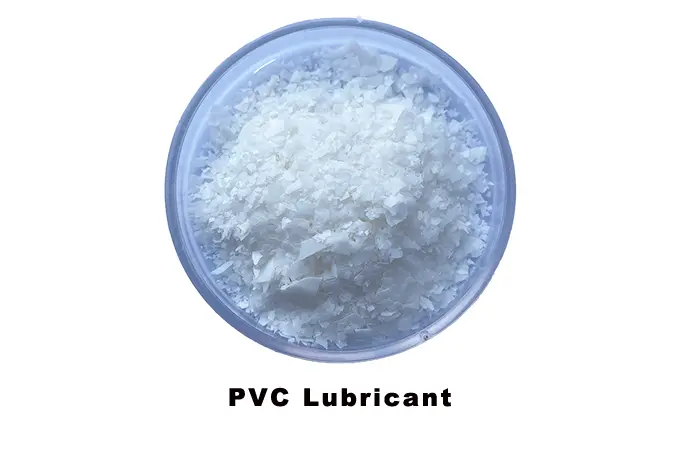
In PVC formulations, lubricants are generally divided into internal and external lubrication systems. Both types influence processing behavior, but they work at different interfaces.
| Lubrication | Main Interface | Typical Effect |
|---|---|---|
| Internal lubrication | PVC polymer chains | Influences melt flow and fusion behavior |
| External lubrication | PVC melt and equipment surface | Reduces sticking and friction during processing |
Internal lubrication mainly affects the movement between PVC molecular chains. It can help control melt flow and influence how quickly the material develops during fusion.
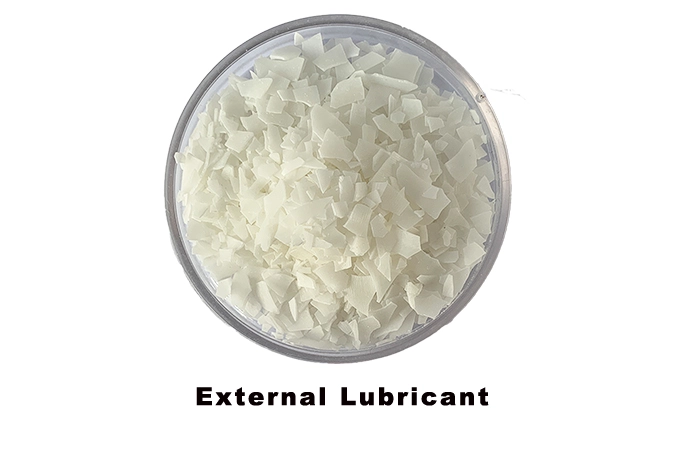
External lubrication works closer to the equipment surface. It helps reduce friction between PVC material and processing equipment, improving release behavior and reducing sticking problems.
A successful PVC formulation usually requires a balance between both lubrication effects. Too much emphasis on one side may create new processing challenges. Therefore, lubricant selection should be based on the complete production process rather than one individual property.
One of the most important relationships in PVC processing is the connection between PVC lubrication and fusion behavior. Fusion determines how PVC particles combine into a uniform melt structure, which directly affects mechanical properties and surface quality.
Lubrication can influence:
Melt friction during processing.
Heat generation inside the material.
Fusion development speed.
Processing stability during extrusion.
A common misunderstanding is that higher lubrication levels always make PVC processing easier. In reality, excessive lubrication may reduce friction too much and delay the fusion process. When external lubrication becomes excessive, PVC particles may take longer to develop the required melt structure.
On the other hand, insufficient lubrication may create excessive friction, increasing torque and processing temperature. This can make production less stable and may contribute to equipment wear.
The ideal lubrication level depends on factors such as PVC resin type, stabilizer system, processing temperature, screw design, and production speed. Manufacturers should evaluate lubrication as part of the entire formulation system.
While lubrication is essential for stable PVC processing, excessive or unbalanced lubrication can contribute to surface defects. These problems are not always caused by lubricant alone, but lubrication behavior should be considered when troubleshooting production issues.
Potential concerns include:
Material deposits around the die area.
Reduced surface consistency.
Changes in gloss or appearance.
Poor interaction with printing or coating processes.
Uneven release behavior.
For example, excessive external lubrication may create an overly slippery interface between PVC melt and equipment surfaces. This can influence fusion development and may contribute to unstable surface quality.
However, surface defects should always be investigated together with other factors, including processing temperature, melt strength, equipment condition, stabilizer selection, and additive compatibility.
This is why experienced manufacturers usually optimize lubrication through formulation testing rather than simply increasing or decreasing lubricant content.
Production problems can provide useful information about possible formulation imbalances. However, lubrication is only one factor among many that should be evaluated.
| Production Symptom | Possible Lubrication Issue | Other Factors to Check |
|---|---|---|
| Excessive torque | Insufficient lubrication | Fusion, temperature, screw conditions |
| Die build-up | Excessive or imbalanced external lubrication | Temperature, formulation |
| Poor surface finish | Lubrication imbalance | Processing aid, melt strength |
| Slow fusion | Excessive external lubrication effect | Temperature, stabilizer system |
| Sticking | Insufficient external lubrication | Die condition, equipment surface |
When diagnosing processing problems, manufacturers should avoid treating lubricant adjustment as the only solution. A change in lubricant level may influence other parts of the formulation, so testing should consider the interaction between lubricants, stabilizers, processing aids, and PVC resin.
A well-balanced lubrication system helps maintain stable processing conditions and improves product consistency across different production runs.

Effective PVC lubrication is not about using the highest possible lubricant content. It is about balancing internal flow, external release, and fusion behavior according to specific processing requirements.
By understanding how lubrication influences friction, melt development, and surface quality, manufacturers can reduce production issues and improve PVC product consistency. Hairuite provides internal and external PVC lubricant solutions, including H-60 and H-74, designed for different processing conditions and formulation requirements.
Excessive or unbalanced lubrication can contribute to die build-up in some processing conditions. However, temperature, formulation compatibility, and equipment condition should also be evaluated.
A higher lubricant dosage, especially excessive external lubrication, may reduce friction too much and slow down fusion development. The optimal level depends on the complete PVC formulation.
Yes. Lubricant selection can influence melt behavior, surface release, and processing stability, which may affect the final surface appearance of PVC products.
Yes. Many PVC formulations use both internal and external lubricants because they provide different effects during processing. The balance between them depends on the application.
Signs may include unstable torque, slow fusion, sticking, die deposits, rough surfaces, or inconsistent product appearance.
No. Different PVC products, processing equipment, temperatures, and production conditions require different lubrication approaches. A suitable system should be adjusted according to the specific application.



 English
 русский
 Español