In rigid PVC applications, impact resistance is one of the most important factors affecting product durability and service life. However, improving toughness is not simply about adding more additives. The interaction between the modifier structure and PVC matrix determines how the final material performs. MBS polymer has become a widely used solution for PVC modification because its unique rubber phase and core-shell structure help absorb impact energy while maintaining transparency and processing stability.
For manufacturers producing PVC sheets, films, profiles, bottles, and other rigid products, understanding how MBS polymer works can help optimize formulation decisions. Instead of focusing only on impact strength, it is important to consider the relationship between polymer structure, dispersion, optical properties, and processing requirements.
The performance of MBS polymer is closely related to its chemical composition. MBS is based on methyl methacrylate, butadiene, and styrene, where each component contributes different functions during PVC modification.
The butadiene component provides a flexible rubber phase that absorbs impact energy, while methyl methacrylate and styrene improve compatibility with the PVC matrix and help maintain material stability. This combination allows MBS to improve toughness without significantly affecting the original characteristics of rigid PVC.
When a PVC product experiences sudden impact, stress can concentrate in specific areas and cause cracks. The rubber phase inside MBS works as an energy absorption zone. Instead of allowing cracks to spread quickly, the rubber particles deform and distribute impact energy throughout the material.
This mechanism makes MBS an effective PVC impact modifier for applications where both mechanical strength and appearance are important. The final performance, however, depends on selecting the right grade and matching it with the overall PVC formulation.
The core-shell structure is one of the main reasons why MBS polymer performs effectively in PVC modification. Unlike a simple rubber additive, MBS is designed with different polymer phases that work together inside the PVC matrix.
The performance process can be understood as:
Impact force → stress concentration → rubber phase deformation → energy dissipation
When external force is applied, the rubber phase absorbs energy through deformation. At the same time, the shell structure helps improve compatibility and supports uniform dispersion within the PVC material.
This structure provides several important benefits:
The rubber phase improves impact absorption by deforming under stress.
The shell phase helps maintain compatibility between MBS particles and PVC.
Controlled morphology supports more consistent impact performance.
The effectiveness of an MBS impact modifier is not determined only by the presence of rubber components. Particle size, dispersion quality, and interaction with PVC also influence the final result. A well-designed core-shell structure allows manufacturers to improve toughness while maintaining better material balance.
One of the biggest challenges in PVC modification is achieving stronger impact resistance without sacrificing transparency. Many rigid PVC products require both durability and good visual appearance, especially transparent sheets, films, and packaging-related applications.
This is where MBS polymer provides a practical advantage. Through controlled rubber phase design, suitable MBS grades can improve impact performance while maintaining optical properties.
Hairuite’s MBS products include grades designed for different PVC applications. For example, RH-707, RH-717, and RH-730 are developed for products such as sheets, films, and bottles where impact strength and transparency need to be considered together.
The relationship between toughness and transparency depends on several factors, including rubber phase structure, particle distribution, and formulation compatibility. A higher impact strength requirement does not always mean sacrificing appearance. With the correct MBS selection, manufacturers can achieve a better balance between mechanical performance and product quality.
The performance of an MBS impact modifier depends on more than its basic composition. Molecular characteristics, dispersion behavior, and compatibility with PVC all influence how effectively the modifier works.
Molecular weight can affect processing behavior and interaction with the PVC matrix, but it should not be considered the only factor determining performance. The ideal characteristics depend on product requirements, processing conditions, and the complete formulation system.
For example, Hairuite’s HR-20 MBS grade provides reference specifications including a molecular weight range of 0.8–1.5 million, bulk density of 0.4–0.55 g/cm³, and volatile content of ≤1.0%.
When MBS particles are evenly dispersed in PVC, the rubber phase can absorb impact energy more effectively. Poor dispersion may reduce modification efficiency and create inconsistent material performance.
Therefore, manufacturers should evaluate MBS selection from a complete perspective, including molecular structure, processing conditions, PVC resin characteristics, and final application requirements.
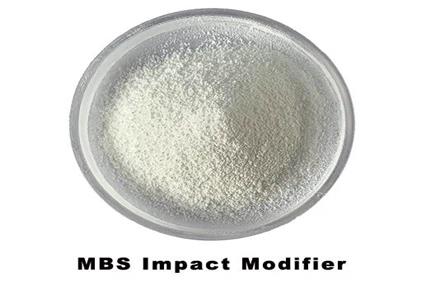
Different PVC products require different performance priorities. Some applications focus on impact resistance, while others require a combination of toughness, transparency, and processing efficiency.
MBS polymer is especially suitable for rigid PVC formulations where improved impact performance is required without significantly affecting appearance.
| Requirement | MBS Suitability |
|---|---|
| Impact resistance | Highly relevant for rigid PVC modification |
| Transparency | Suitable for selected transparent PVC applications |
| Low-temperature toughness | Helpful for products requiring improved durability |
| Outdoor weatherability | Requires additional formulation consideration |
| Processing performance | Depends on grade selection and processing conditions |
For example, transparent PVC sheets may prioritize optical performance, while profiles and molded products may place more emphasis on mechanical strength. The most suitable modifier depends on the final application rather than one single specification.
Manufacturers should consider PVC resin type, processing method, product environment, and performance expectations before selecting an MBS grade.
The performance of MBS polymer comes from the interaction between its rubber phase, core-shell structure, and PVC matrix. By controlling polymer morphology and dispersion, manufacturers can achieve a better balance between impact resistance, transparency, and processing stability.
Selecting the right MBS solution requires understanding product requirements and formulation conditions rather than focusing on one performance value alone. Hairuite provides MBS solutions for different PVC applications, supporting manufacturers in optimizing material performance.
MBS stands for methyl methacrylate-butadiene-styrene. It is an impact modifier designed to improve the toughness of rigid PVC materials through its rubber phase and structural design.
The rubber phase helps absorb impact energy by deforming under stress. This reduces crack propagation and improves the impact resistance of PVC products.
Yes. Certain MBS polymer grades are designed to improve impact performance while maintaining good transparency. The final result depends on formulation design and application requirements.
Molecular weight can influence processing and material behavior, but final impact performance also depends on dispersion quality, morphology, PVC compatibility, and processing conditions.
No. MBS is mainly used for applications requiring impact modification. Different PVC products may need different modifier systems depending on performance targets.
A plasticizer mainly improves flexibility by reducing polymer stiffness, while MBS improves impact resistance through its rubber phase and core-shell structure.



 English
 русский
 Español